
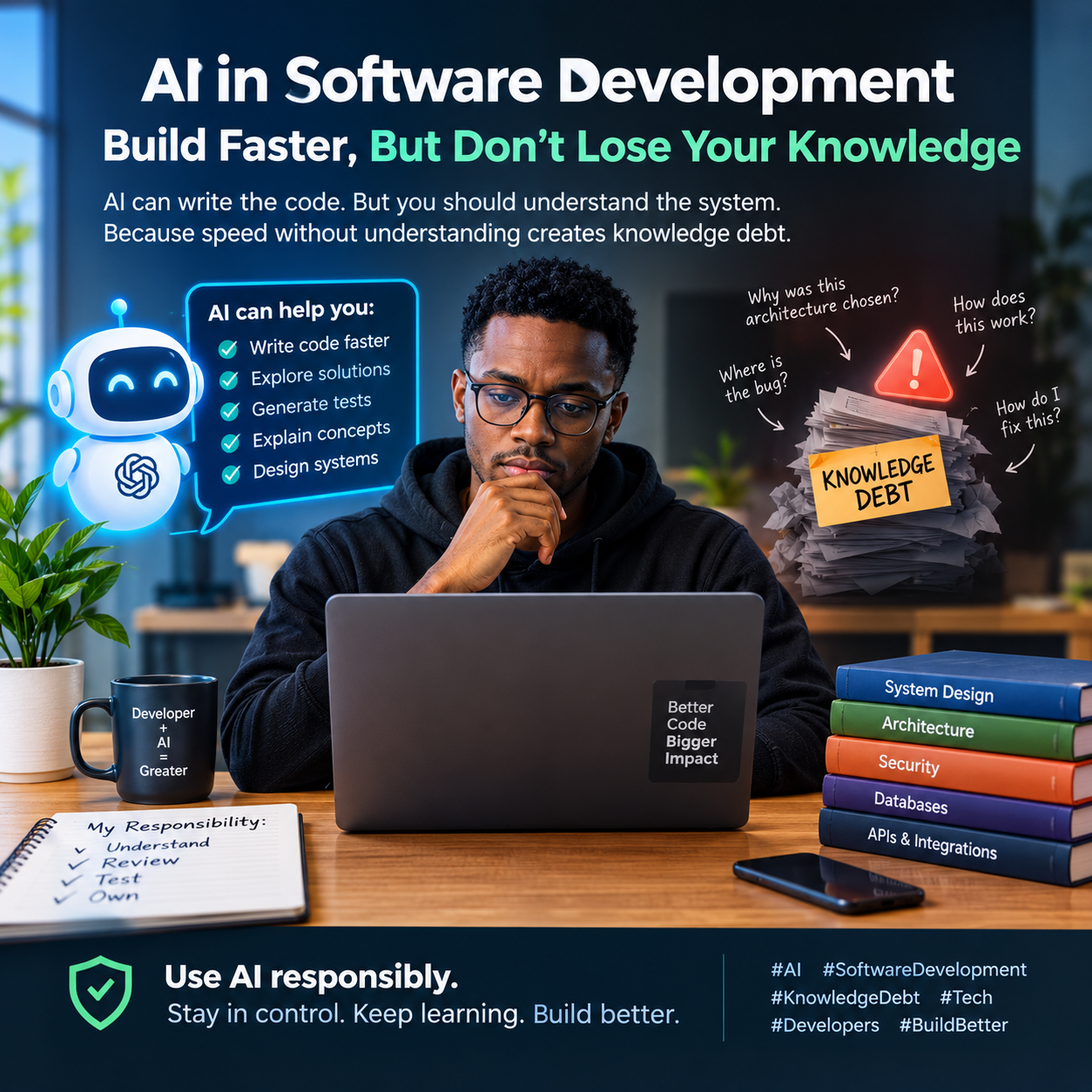
Artificial intelligence is changing the way software developers build applications.
AI coding tools can help developers write code faster, explore solutions, generate tests, explain unfamiliar concepts, and even assist with system design.
There is no doubt that AI is becoming an important part of modern software development. Developers should learn how to use it and take advantage of what it can do.
But there is another side of AI-assisted development that we need to talk about: knowledge debt.
What Is Knowledge Debt in Software Development?
Knowledge debt happens when a developer or development team becomes dependent on technology, tools, or AI-generated solutions without developing enough understanding of how those solutions actually work.
It is similar to technical debt in one important way: the problem may not be obvious at the beginning.
You may use AI to generate an entire feature in a few minutes. The code may work. The application may pass your initial tests. You may even deploy it successfully.
The problem can appear later when something unexpected happens.
A production application crashes. An API starts returning unexpected responses. A database query becomes slow. Authentication stops working correctly. A security issue is discovered. Or a business requirement changes and part of the system needs to be redesigned.
At that point, the important question becomes:
Do you understand the system well enough to fix it?
If the answer is no because AI made most of the architectural and implementation decisions for you, the time saved during development can quickly turn into time lost during debugging, maintenance, and future development.
This is where knowledge debt can become expensive.
AI Can Write the Code, But Should It Own the System?
Imagine you are building a production application and you ask AI to handle almost everything.
- AI designs the system architecture.
- AI chooses the libraries and frameworks.
- AI designs the database structure.
- AI writes most of the business logic.
- AI creates the API endpoints.
- AI implements authentication.
- AI fixes bugs whenever something goes wrong.
You may end up with a working application.
But there is a difference between having working software and understanding the software you own.
As developers, we should be careful not to confuse the ability to generate software with the ability to engineer software.
Software engineering involves understanding requirements, making architectural decisions, evaluating trade-offs, thinking about security and scalability, testing assumptions, and understanding how different parts of a system interact.
AI can assist with many of these activities.
But the developer still needs to understand the decisions being made.
Why Knowledge Debt Can Become a Problem
The biggest danger is not necessarily that AI will generate bad code.
Sometimes the code can be perfectly reasonable.
The bigger problem is that a developer may accept a solution without developing the knowledge required to maintain it.
For example, an AI tool might suggest a particular architecture for a web application. If you understand the architecture, you can evaluate whether it makes sense for your application's requirements.
But if you simply accept the recommendation because it works, you may not understand the trade-offs involved.
Months later, the application may grow and the architecture may no longer fit the new requirements.
At that point, you have to understand a system that you did not fully design or understand in the first place.
This is where knowledge debt can become expensive.
How Developers Can Use AI Without Creating Knowledge Debt
I don't think the answer is to stop using AI.
In fact, I believe developers should embrace AI and learn how to use it effectively.
The important part is to use AI without giving up ownership of the engineering process.
1. Understand the Architecture
If AI suggests an architecture, take the time to understand it before implementing it.
Ask why certain components are needed, how they communicate, and what alternatives were considered.
You should be able to explain the architecture to another developer without asking an AI tool to explain your own system.
2. Do Not Blindly Accept AI-Generated Code
AI-generated code should be reviewed like code written by another developer.
Read it.
Test it.
Question it.
Check whether it follows the requirements and whether it introduces security, performance, maintainability, or reliability problems.
The fact that code compiles or passes a simple test does not automatically mean it is the right solution.
3. Make Important Engineering Decisions Yourself
AI can provide recommendations, but developers should remain involved in important decisions involving architecture, databases, security, authentication, infrastructure, APIs, and business logic.
Ask AI for different approaches and their trade-offs.
Then use your own engineering judgment to decide which approach fits the project.
4. Ask AI to Explain, Not Just Generate
One of the best ways to use AI for learning is to ask it to explain the reasoning behind a solution.
Instead of only asking:
"Write an authentication system for my application."
Also ask questions such as:
"Why did you choose this approach?"
"What are the security risks?"
"What alternatives could I use?"
"What could go wrong in production?"
"How would this scale as the application grows?"
This turns AI from a simple code generator into a tool that can help you deepen your understanding.
5. Understand the Critical Parts of Your System
You do not necessarily need to understand every line of code at the same level.
But you should understand the critical parts of your application.
For example:
- Authentication and authorization
- Database design and relationships
- API communication
- Security controls
- Business logic
- Application architecture
- Deployment and infrastructure
- Error handling and monitoring
These are areas where a lack of understanding can become particularly painful when a production system develops a problem.
6. Make Sure You Can Debug Without AI
AI can be extremely useful when debugging.
There is nothing wrong with asking an AI tool to help investigate an error.
But you should not become completely dependent on it.
Try to understand the error yourself first.
Look at the logs. Follow the request flow. Check the database. Reproduce the problem. Understand what changed.
Then use AI to help you investigate possible solutions.
The goal is not to avoid AI.
The goal is to make sure that you can still reason about your own system when AI is not available.
AI Should Increase Your Capabilities, Not Reduce Your Understanding
I believe the future of software development will involve much more collaboration between developers and AI.
Developers who know how to use AI effectively will be able to move faster and experiment with ideas that previously required much more time.
But speed should not come at the cost of understanding.
The goal should not be to become a developer who can generate the most code with AI.
The goal should be to become a developer who can use AI to build better software while still understanding and owning the system.
AI can write code.
AI can suggest architectures.
AI can help find bugs.
AI can explain concepts and help developers learn.
But developers still need to understand what they are building and why they are building it that way.
Final Thought
I am not against using AI in software development.
Quite the opposite.
I believe developers should embrace it and learn how to use it responsibly.
My concern is what happens when we allow AI to take over so much of the development process that we stop understanding the systems we are building.
Production software needs ownership.
When something breaks, someone needs to understand the system well enough to investigate the problem, make the right decision, and implement a reliable solution.
Use AI. Embrace it. Learn from it. But stay in control of your software.
The best developers of the AI era may not be the ones who use AI to do everything.
They may be the ones who know what to delegate to AI, what to verify, what to learn, and what they must understand themselves.
What Do You Think?
Is AI making developers more productive, or are we creating a generation of developers who may struggle to understand the systems they build?
Share your thoughts in the comments.